
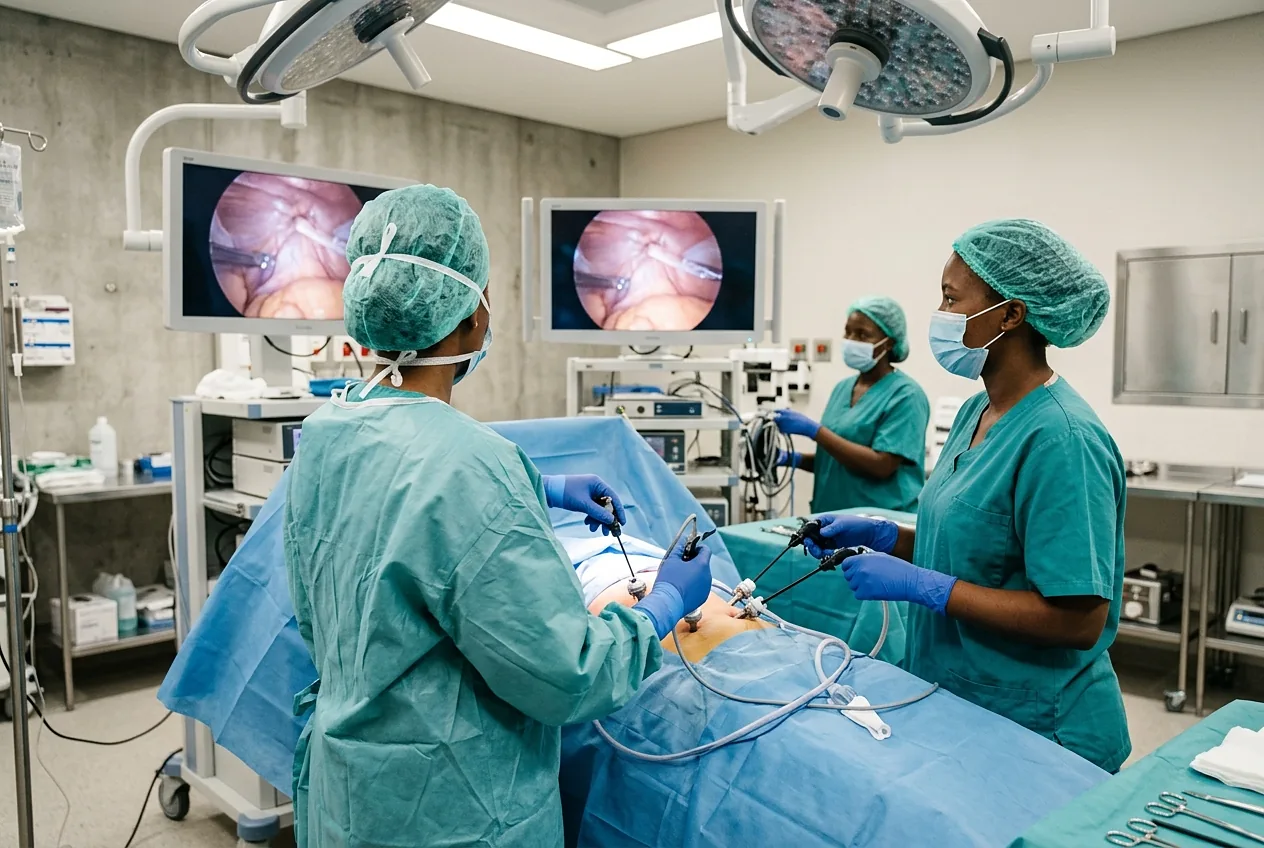
Laparoscopic & Hysteroscopic Minimally Invasive Surgery in Mahikeng
Advanced diagnostic and operative laparoscopy and hysteroscopy performed by Dr Tebo Rasenyai (FCOG SA) at Clinix Victoria Private Hospital — enabling precise treatment of ovarian cysts, ectopic pregnancy, endometriosis, uterine polyps, and fibroids with minimal incisions and faster recovery.
Your questions, answered simply
Tap a topic to read more.
Clinical Indications for Laparoscopic & Hysteroscopic Procedures
Minimally invasive gynaecological surgery encompasses two complementary endoscopic modalities: laparoscopy (which visualises the pelvic and abdominal cavity through a slender high-definition camera introduced at the umbilicus) and hysteroscopy (which inspects the inside of the uterine cavity through the natural cervical canal without any external skin incisions).
At Clinix Victoria Private Hospital, Dr Tebo Rasenyai utilises endoscopic surgery to diagnose and treat a wide spectrum of benign gynaecological and reproductive conditions while preserving healthy ovarian and uterine tissue.
- Operative Laparoscopy: Ovarian cystectomy (dermoid, endometriotic, or persistent simple cysts), excision or ablation of endometriosis, division of pelvic adhesions, management of ectopic pregnancy, laparoscopic sterilisation, and selected myomectomy or hysterectomy procedures.
- Diagnostic & Operative Hysteroscopy: Resection of endometrial polyps and submucosal fibroids causing heavy bleeding, division of intrauterine adhesions (Asherman's syndrome) or uterine septum, targeted endometrial biopsy, and retrieval of displaced intrauterine contraceptive devices.
Benefits of Minimally Invasive Keyhole Surgery vs Open Laparotomy
Compared with traditional open abdominal surgery (laparotomy), laparoscopic and hysteroscopic procedures offer substantial physiological and recovery advantages. Magnified high-definition visualisation allows delicate dissection around the fallopian tubes, ovaries, and ureters, reducing intraoperative blood loss and minimising post-operative scar tissue formation.
Most patients undergoing diagnostic laparoscopy or operative hysteroscopy are discharged on the same day or following a single overnight hospital stay, returning to normal daily activities within one to two weeks rather than the six weeks typically required after open abdominal surgery.
How to Prepare for a Surgical Consultation & Pre-Operative Workup
If you have been referred for a surgical opinion or are seeking a second opinion regarding a recommended gynaecological operation, please bring all prior ultrasound reports, MRI scans, blood test results (such as haemoglobin, iron studies, or CA-125 tumour markers), and any previous surgical theatre records.
During your consultation in Suite D, Room 2, Dr Rasenyai performs a comprehensive pelvic ultrasound mapping and discusses both non-surgical alternatives and surgical options, explaining the exact procedure, expected recovery timeline, and any implications for future fertility.
Hospital Theatre Care, Post-Operative Recovery & Medical Aid Pre-Authorisation
Once a surgical plan is agreed upon and informed consent is completed, our practice prepares a detailed clinical motivation letter, ICD-10 diagnostic codes, and RPL surgical procedure codes for your medical aid scheme's hospital pre-authorisation department.
Following surgery at Clinix Victoria Private Hospital, you receive clear written discharge instructions covering wound care, analgesia, warning signs, medical certificate (sick leave) documentation, and a scheduled post-operative review in our rooms.
Ready when you are.
All medical aids welcome, with no co-payments on consultations.
Patients often ask
How long is the recovery time after a laparoscopic gynaecological procedure?
For diagnostic laparoscopy or ovarian cystectomy, most patients stay in hospital for 1 day and return to desk work within 7 to 10 days. More extensive operative laparoscopies (such as myomectomy or laparoscopic hysterectomy) typically require 2 to 3 weeks of recovery, which is still significantly shorter than the 6 weeks needed after open surgery.
Does hysteroscopy leave any scars on the abdomen?
No. A hysteroscope is passed gently through the vagina and cervix into the uterine cavity, so there are no abdominal incisions or external sutures required.
Will my medical aid cover laparoscopic surgery at Clinix Victoria Private Hospital?
Yes, medically indicated gynaecological surgeries are covered by hospital plans and comprehensive medical aid options subject to scheme pre-authorisation. Our reception team provides all clinical codes and motivation reports required for your pre-authorisation.
Related care

Fibroids, Endometriosis & Pelvic Pain
Painful or heavy periods are not something you should simply live with.
Learn more
Fertility & Planning a Pregnancy
Step-by-step support when you’re trying for a baby or getting ready to.
Learn more
PCOS & Period Problems
Answers and a clear plan for irregular, heavy or missed periods.
Learn moreLet’s talk about your care
Consultations take place in our rooms at Clinix Victoria Private Hospital, First Floor, Suite D, Room 2, Mahikeng.
Request an appointment
Fill this in and we’ll open a ready-to-send WhatsApp message to our reception. We usually reply within working hours.